Turn Data and AI Ambition Into an Executable Strategy
We align data and AI priorities with business outcomes, assess current capabilities and establish a pragmatic roadmap for transformation.
Core Capabilities
Data strategy
AI strategy
Current-state maturity assessment
Target-state definition
Data and AI operating model
Business-value identification
Initiative prioritization
Target architecture
Transformation roadmap
Business case and KPI definition
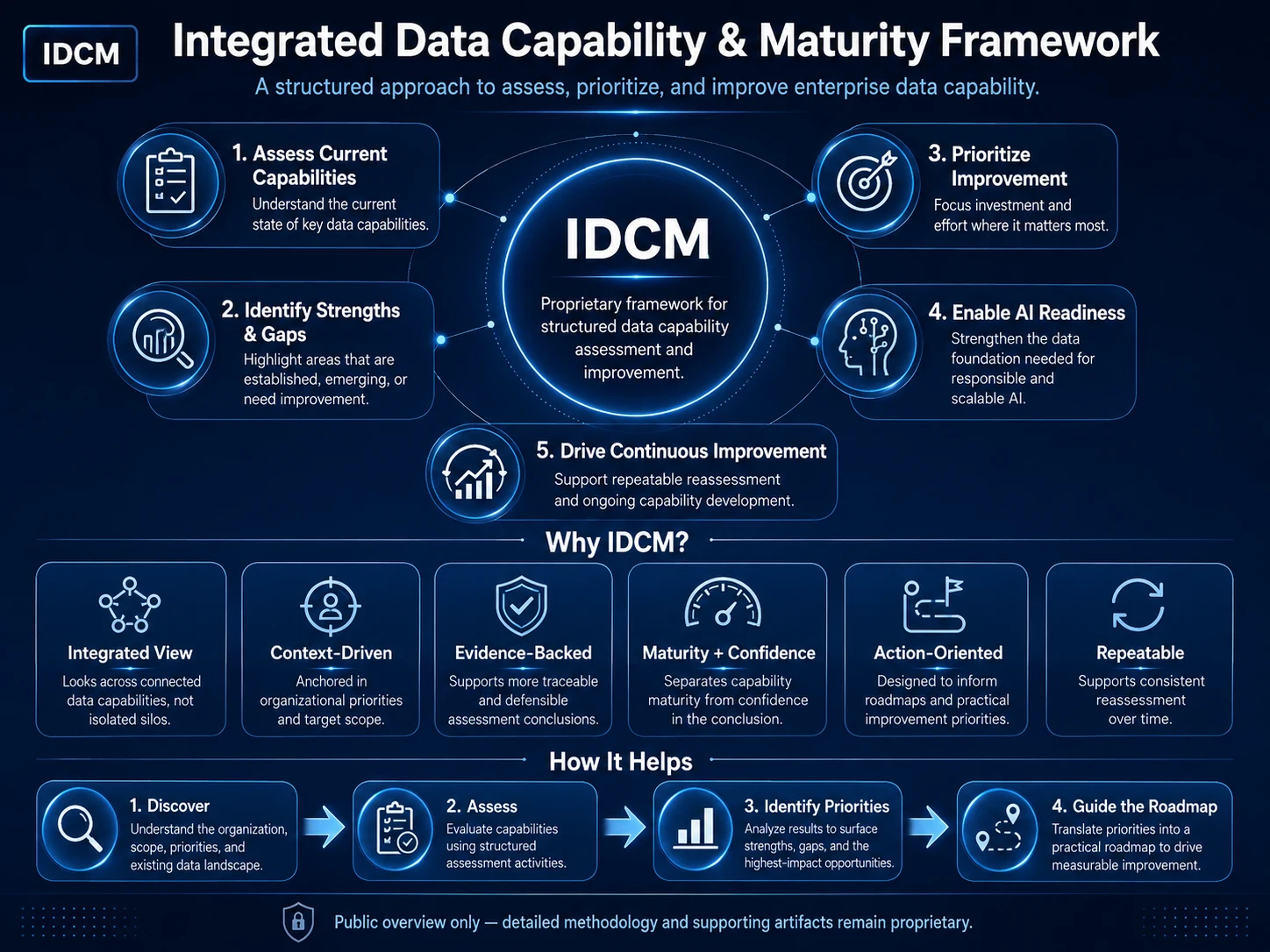
Integrated Data Capability & Maturity Framework
Why IDCM?
Many established data maturity frameworks provide valuable reference models for understanding data-management practices. IDCM is designed for organizations that need to go a step further — connecting capability maturity, evidence, business priorities, and improvement planning within one integrated assessment approach.
What capabilities matter in their context
How mature those capabilities are
How confidently that maturity can be demonstrated
Where improvement should be prioritized
How progress can be reassessed consistently over time
01
A Connected View of Data Capability
IDCM evaluates data capability as an interconnected system rather than as isolated governance, quality, architecture, metadata, or analytics activities.
The objective is to understand how capabilities reinforce one another across the organization.
02
Built Around Your Actual Scope
The assessment is anchored in the organization’s target scope, priorities, operating context, and intended outcomes rather than applying a generic maturity profile without context.
The framework helps focus attention on the capabilities that matter most to the organization.
03
Maturity Must Be Demonstrable
IDCM is designed to distinguish between an asserted capability and one that can be supported by appropriate evidence.
Assessment conclusions are intended to be traceable and defensible, rather than based only on interviews or perception.
04
Know Both the Maturity and the Confidence
IDCM separates the question “How mature is this capability?” from “How strongly can that conclusion be supported?”
This helps decision-makers understand both capability maturity and the strength of the assessment conclusion.
05
Designed to Drive Improvement
The purpose of the assessment is not simply to produce a maturity score. IDCM is designed to help organizations identify capability gaps, understand dependencies, prioritize improvement, and build a practical roadmap.
Assessment should lead to action, not end with a benchmark.
06
Designed for Repeatable Assessment
IDCM is designed to support consistent reassessment over time and reduce unnecessary variation between assessors.
This helps organizations track genuine capability improvement rather than changes in interpretation.
How IDCM Differs in Assessment Philosophy
Dimension
Traditional Maturity Assessment
IDCM Approach
Assessment focus
Often maturity against a reference model
Integrated capability maturity within a defined organizational context
Evidence
May rely heavily on interviews, documentation, or assessor judgement
Designed to explicitly connect conclusions to supporting evidence
Output
Frequently centered on maturity levels or scores
Maturity view plus confidence in the supporting assessment and improvement priorities
Scope
Often applies a predefined domain structure
Assessment is anchored to an explicitly defined target scope
Improvement
Gap analysis may follow the assessment
Improvement prioritization is designed as part of the assessment outcome
Reassessment
Can vary by implementation
Designed with repeatability and assessment consistency in mind
Complementary to Established Standards
IDCM is not intended to invalidate established bodies of knowledge or industry frameworks. Organizations may continue to use standards and reference models such as DAMA-DMBOK, DCAM, CMMI, regulatory frameworks, or internal capability models. IDCM provides an integrated assessment approach that can help organizations structure capability evaluation, evidence, prioritization, and improvement around their own context.
When IDCM May Be the Right Fit
Choose an IDCM-based assessment when you need to:
Assess capability across multiple connected data disciplines
Move beyond a single maturity score
Require evidence-backed conclusions
Distinguish maturity from assessment confidence
Focus on a defined organizational scope
Prioritize practical improvement actions
Reassess consistently over time
Connect maturity assessment to transformation planning
Move Beyond a Maturity Score
Use IDCM to establish a structured, evidence-backed view of your data capabilities and translate the assessment into clear improvement priorities.
From Ambition to Executable Roadmap
01 // Assess
Understand the organization's strategy, current initiatives, capabilities, pain points and maturity.
02 // Align
Capture executive priorities, business outcomes and stakeholder expectations.
03 // Define Target State
Define governance, architecture, organization, technology and capability target state.
04 // Prioritize
Create a portfolio of initiatives based on business value, dependency, risk and feasibility.
05 // Build the Roadmap
Define sequencing, quick wins, KPIs, investment requirements and delivery governance.
06 // Mobilize
Establish sponsorship, accountable owners and execution governance.
Turn Your Data & AI Ambition Into an Operating Capability.
Discuss your priorities with a senior bAIyanat practitioner and identify the fastest path from current-state challenges to measurable outcomes.